Hi everyone,
A daily spoonful of prebiotic fiber eased knee arthritis pain about as much as a supervised exercise program. That is a surprising result, and an easy one to act on. I also found a few other studies I thought were interesting and useful for staying healthy: coffee and the liver, a fourfold heart risk hiding inside a common hormone condition, what yo-yo dieting costs your legs, and why TV time and desk time age the brain differently. Plus a podcast on lowering Alzheimer’s risk even if you carry APOE4.
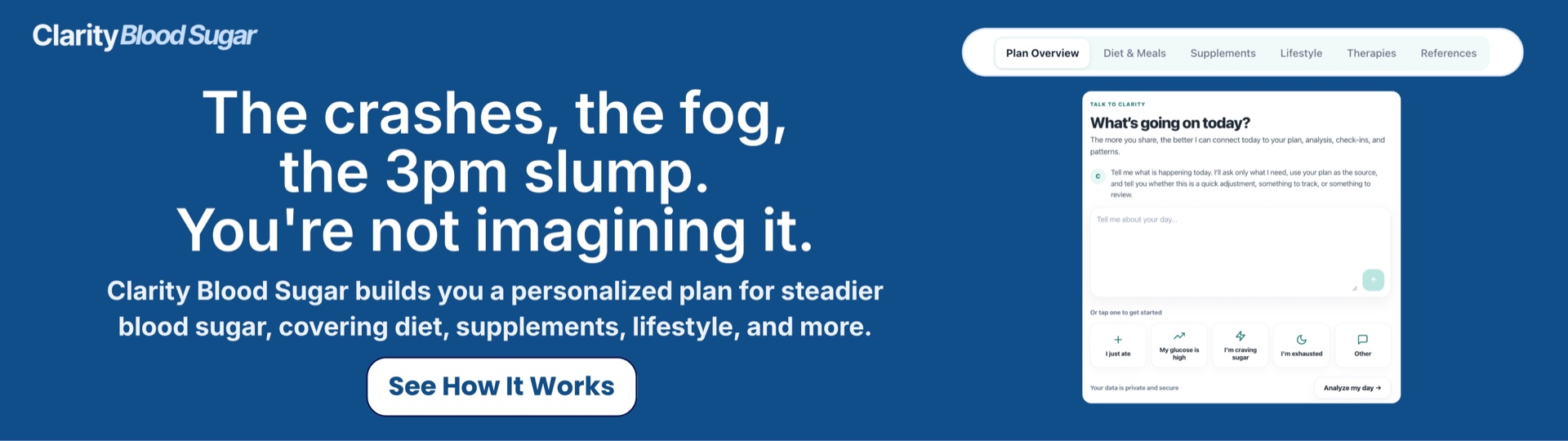
Quick note before we start. Two of the stories below, the fiber trial and the PCOS heart data, come back to the same place: how steady your blood sugar runs from one meal to the next. If that is something you are working on, whether it is prediabetes, diabetes, or just the afternoon crash that keeps showing up, Clarity uses AI to build a plan around your own situation and then coaches you on it day to day. Take a look below. It is a product I recommend, and it is worth two minutes to see if it fits what you are dealing with.
This Week’s Podcast Spotlight
Episode 65: You Can Lower Your Alzheimer’s Risk, Even With the APOE4 Gene, with Dr. Peter McCullough
This one is a role reversal. Instead of hosting, I was the guest, sitting down with Dr. Peter McCullough on the McCullough Report to talk about Alzheimer’s and cognitive decline. Both of his parents lived with the disease, his father died with it, and his mother has advanced disease right now, so the conversation got personal fast. I carry an APOE4 variant myself, which is part of why this subject follows me around. We covered why the brain makes amyloid from the day you are born, why the drugs that clear it have mostly failed, the new blood tests that can catch the disease before any symptoms show up, and the diet and lifestyle levers that outperform every approved medication we have. It turned into one of my favorite conversations on the topic, so I brought it home to share here.
Three points from the conversation:
- Your genes are not your destiny. Nigerians carry very high rates of APOE4 and have almost no Alzheimer’s among people eating a traditional diet. The variant loads the gun; lifestyle decides the rest.
- Deep sleep is when the brain takes out the trash. The glymphatic system flushes beta amyloid out while you sleep, and a single night of sleep deprivation raises brain beta amyloid by about 5%.
- Hearing loss is the most fixable risk factor we have. Left uncorrected, it is tied to up to a 50 to 60% increase in dementia risk, and today’s hearing aids solve it.
This Week in Health Science
Five studies from this week’s research, and I think you will find a few of them practically useful.
The Fiber That Went Head to Head With Physical Therapy

Researchers in Nottingham put 117 adults with knee osteoarthritis into four groups: 20 grams a day of inulin, an app-guided physiotherapy exercise program, both, or a placebo. Over six weeks, the fiber and the exercise both beat placebo for pain, and the fiber did something exercise did not. It lowered pain sensitivity, meaning the nervous system itself turned the volume down, and it raised blood butyrate, the compound your gut bacteria make when they ferment fiber. Only 3.6 percent quit the fiber arm, versus 21 percent in the exercise arm. Exercise is still the cornerstone of arthritis care, but a treatment nobody sticks with does not help anyone. One caution: 20 grams of fermentable fiber is a lot, so build up slowly over a few weeks or you will be bloated and miserable.
Key finding: Inulin lowered knee pain by 1.11 points and the exercise program by 1.55 points on a 10-point scale, but only the fiber group also showed reduced pain sensitivity, higher butyrate, and better grip strength, with a dropout rate of 3.6 percent versus 21 percent.
Good News for Your Morning Cup

I drink coffee every day, so I read this one with an obvious bias, and it still held up. Researchers followed 354,957 UK Biobank adults for about 13 years, and the more coffee people drank, the lower their risk of cirrhosis, liver cancer, and liver-related death. What convinced me is that they did not stop at outcomes. MRI scans showed less liver fat, less iron, and less scarring in heavier coffee drinkers, and blood work showed a distinct protein signature. Decaf worked too, which tells us the benefit is coming from the hundreds of plant compounds in coffee rather than the caffeine. It is observational, so it is a strong link rather than proof, but if you already enjoy your coffee, there is no reason here to cut back. Just watch what you put in the cup.
Key finding: People drinking five or more cups a day had a 32% lower risk of cirrhosis, a 47% lower risk of liver cancer, and a 42% lower risk of liver-related death, with the same benefits showing up for decaf.
A Heart Risk Hiding Behind a Hormone Diagnosis

About 1 in 10 women of reproductive age have polycystic ovary syndrome, now renamed polyendocrine metabolic ovarian syndrome because it was never really just an ovary problem. In 413,450 US women compared against more than 2 million without it, artery disease showed up about three times as often over a decade. These women averaged 31 years old. We usually save the heart conversation for someone’s fifties. And the extra risk persisted even after adjusting for obesity, high blood pressure, cholesterol, and diabetes, so a normal weight and a normal blood pressure are not enough reassurance. If you were told years ago that you had PCOS and the conversation ended there, this is a good reason to reopen it.
Key finding: Women with PCOS had about 4.4 times the risk of atherosclerotic cardiovascular disease, with roughly 12 percent developing artery disease over 10 years compared with about 4 percent of women without the condition.
What Yo-Yo Dieting Costs Your Muscle

This is the study I have wanted to see for a long time. Researchers took 1,433 adults whose weight barely moved over four years, then asked whether the path they took mattered. It did. The people whose weight repeatedly rose and fell lost nearly four times more thigh muscle on MRI than the people who stayed steady, even though both groups finished at basically the same weight. Fat measures were identical between them. The asymmetry is the whole story: you lose fat and muscle together on the way down, and it comes back mostly as fat on the way up. Do that a few times in your sixties and you have traded muscle for fat while the scale sat still. The fix is not to stop losing weight. It is to lose it slowly, lift something twice a week while you do, and keep your protein up.
Key finding: Weight cyclers lost 3.71% of their thigh muscle volume over four years compared with 1.03% in weight-stable adults, with no difference in fat inside the muscle or around the knee.
Not All Sitting Is the Same

We lump all sitting together and call it bad. This study of 1,712 adults says that is too simple. Researchers recorded two habits in the late 1980s, TV watching and sitting at work, then scanned everyone’s brains with MRI about 25 years later. Frequent TV watchers had more small vessel damage and smaller volumes in the regions that shrink first in Alzheimer’s disease, and that held after accounting for exercise, weight, diabetes, smoking, and alcohol. Desk sitters went the other way. I would not read that as desk work building a better brain, since office jobs in 1988 tracked closely with education and income. But the difference makes a real point: what your brain is doing while you sit may matter more than how long you sit. Reading, conversation, and learning something hard are not the same as three hours of passive screen time.
Key finding: Adults who watched TV “very often” in midlife had greater white matter hyperintensity volume and smaller frontal, occipital, and Alzheimer’s signature brain volumes 25 years later, while those who sat more at work showed the opposite pattern.
Stay curious. Stay skeptical. And stay healthy.
Dr Kumar