Hi everyone,
Almost nine in ten US heart disease deaths trace back to risk factors we can change, and high blood pressure alone drives nearly half of them. I thought that was really significant and practical. I also found a few other studies I thought were interesting and useful for staying healthy: a cheap old drug for long COVID fatigue, semaglutide and biological aging, teen phone use and sleep, and nerve blocks that prevent pain months later. Plus a podcast about the blood sugar crash that hides on a normal lab.
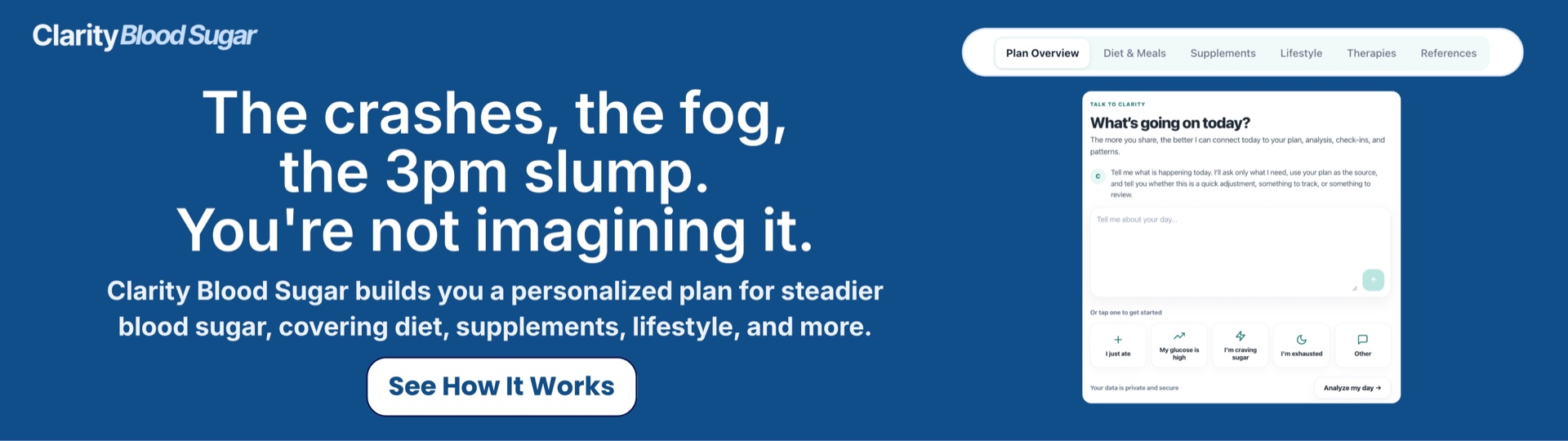
Before we get into it, one thing I want to share. If you have issues with your blood sugar, prediabetes, or diabetes, having daily guidance, feedback, and education tailored to your exact set of conditions can be really helpful. That is where AI comes in. Check out Clarity below. It is a product I recommend, and I think it is worth a look to see if it can help you.
This Week’s Podcast Spotlight
Episode 64: The Prediabetes Warning Sign Your Doctor Is Not Testing For, with Dr. Keith Berkowitz
I sat down with Dr. Keith Berkowitz, who went to work alongside Dr. Robert Atkins in the late 1990s and carried that way of practicing forward for 30 years after Atkins died. The reason I wanted to cover this one is that reactive hypoglycemia may be the single most common thing in medicine that almost nobody gets tested for. It is your blood sugar crashing in the first few hours after a meal, and the symptoms are so ordinary that people file them under normal life: the 3pm fog, the wave of tiredness after lunch, the hangry crash, the vivid dreams, the reach for coffee or something sweet just to focus. It is also one of the earliest warning signs on the road to prediabetes and diabetes, which means it is one of the few problems you can catch two decades before it shows up as a diagnosis. We also get into the low fat era, how the sugar industry helped villainize fat and eggs, the gut microbiome, and how a continuous glucose monitor finally makes this visible.
Three things that stood out:
- The crash comes from too much insulin, not too little food. Blood sugar dives in the hours after eating because the pancreas overshoots, and Dr. Berkowitz thinks as much as half the population has some version of this.
- The symptoms come from cortisol, not the low sugar itself. The shakiness, sweating, anxiety, and racing heart are your stress hormone hauling glucose back up. Vivid dreams at night are often the same thing.
- A normal fasting glucose is not a clean bill of metabolic health. Insulin resistance can build for 20 years before glucose ever looks high, which is why he looks at insulin too and leans on a continuous glucose monitor.
This Week in Health Science
Here is what stood out from the research this week. These studies fascinated me, and I think you will find a few of them practically useful.
Nine Out of Ten Heart Deaths Were Preventable

Most people I talk to assume heart disease is mostly genetics and bad luck. This analysis of 33 years of US mortality data says otherwise. Blood pressure alone was tied to 47.2% of these deaths, and it is one of the most treatable conditions in all of medicine, which makes an appointment to get a cuff on your arm a surprisingly high-value use of an afternoon. The part that concerns me is the trend underneath the good news: death rates fell 58.7% since 1990, mostly from less smoking and cleaner air, while the harm tied to high body mass index rose 54.5% and the harm from high blood sugar rose 38.8%. Metabolic health is the next frontier, and it is a harder problem than any single pill.
Key finding: An estimated 88.7% of the roughly 473,000 US deaths from ischemic heart disease in 2023 were attributable to modifiable risk factors, with high systolic blood pressure alone linked to 47.2% of them.
An Old, Cheap Drug That Finally Moved Long COVID Fatigue

Long COVID fatigue has been one of the most frustrating problems in medicine, because millions of people are wiped out for months and almost nothing has been proven to help. This randomized, placebo-controlled trial of 399 adults tested low-dose fluvoxamine, an older and inexpensive SSRI that also seems to calm inflammation, and it worked. What I find most convincing is that the benefit was still there at day 90 rather than fading, and side effects were actually less common on the drug (20.0%) than on placebo (29.7%). The same trial tested metformin and it did nothing for established fatigue, which the researchers reported honestly and stopped early. Fluvoxamine is a real medication with real interactions, so this is a conversation to have with your doctor, not a self-experiment.
Key finding: After 30 days, people on 100 mg of fluvoxamine twice a day were nearly 50% more likely than the placebo group to rate their long COVID fatigue as minimal, and the benefit held through day 90.
A Weight Loss Drug That May Also Touch Aging

We already knew semaglutide reshapes weight and blood sugar. This randomized, double-blind trial asked whether it reaches deeper, into the biology of aging itself, by reading the chemical tags on people’s DNA that shift in predictable ways as we get older. Every clock they measured pointed the same direction, and the real-time pace of aging ran about 9 percent slower on the drug. Now the caution, because it matters: this was an add-on analysis of a trial designed to study belly fat, in 84 adults living with HIV, over just 32 weeks. It is a strong hypothesis, not a settled fact, and nobody should take semaglutide chasing these numbers.
Key finding: On the PhenoAge clock, semaglutide slowed biological aging by about 4.9 years per year of treatment versus placebo, with parallel drops on four other clocks and markers of inflammation, brain, and heart aging.
It Is Not the Phone, It Is How Much They Use It

This is the rare screen-time study that refuses to give the lazy answer. Researchers followed 1,959 US teens, looked at their phone habits at 13, then checked their health at 14. Simply owning a first phone did not predict depression or obesity a year later. Heavy use did, and it tracked with all three problems at once: depression, obesity, and not enough sleep. The finding I would act on tonight is the smallest one. Teens who kept the phone out of the bedroom at night had lower odds of insufficient sleep, and moving the charger to the kitchen costs nothing.
Key finding: Getting a first smartphone at 13 was not linked to depression or obesity at 14, but greater intensity of use was tied to higher odds of depression, obesity, and inadequate sleep, while keeping the phone out of the bedroom protected sleep.
The Question to Ask Before Your Next Operation

Chronic postsurgical pain is pain that starts after an operation and never fully leaves, and it is miserable to treat once it sets in. This review pooled 158 randomized trials covering 18,794 adults and found that numbing the nerves carrying signals from the surgical site, rather than relying on general anaesthesia alone, meaningfully lowered the odds of ending up in that group a year later. As a neurosurgeon, this lines up with something we have suspected for years: how the nervous system handles pain during and right after surgery helps decide whether it gets stuck in a lasting pattern. The certainty of the evidence was rated low, so hold the exact numbers loosely, but the direction across 158 trials is consistent enough that it is worth raising with your anaesthesiologist.
Key finding: Regional anaesthesia cut the risk of chronic postsurgical pain by about 27% (risk ratio 0.73) out to 12 months, with the clearest benefits after mastectomy, chest surgery, and knee replacement.
My book, 2mm, is almost here. It is the story of seven years inside the operating room, where every decision is measured in millimeters and every millimeter matters. If you want to be the first to know when it is available, leave your email at 2mmbook.com.
Stay curious. Stay skeptical. And stay healthy.
Dr Kumar