
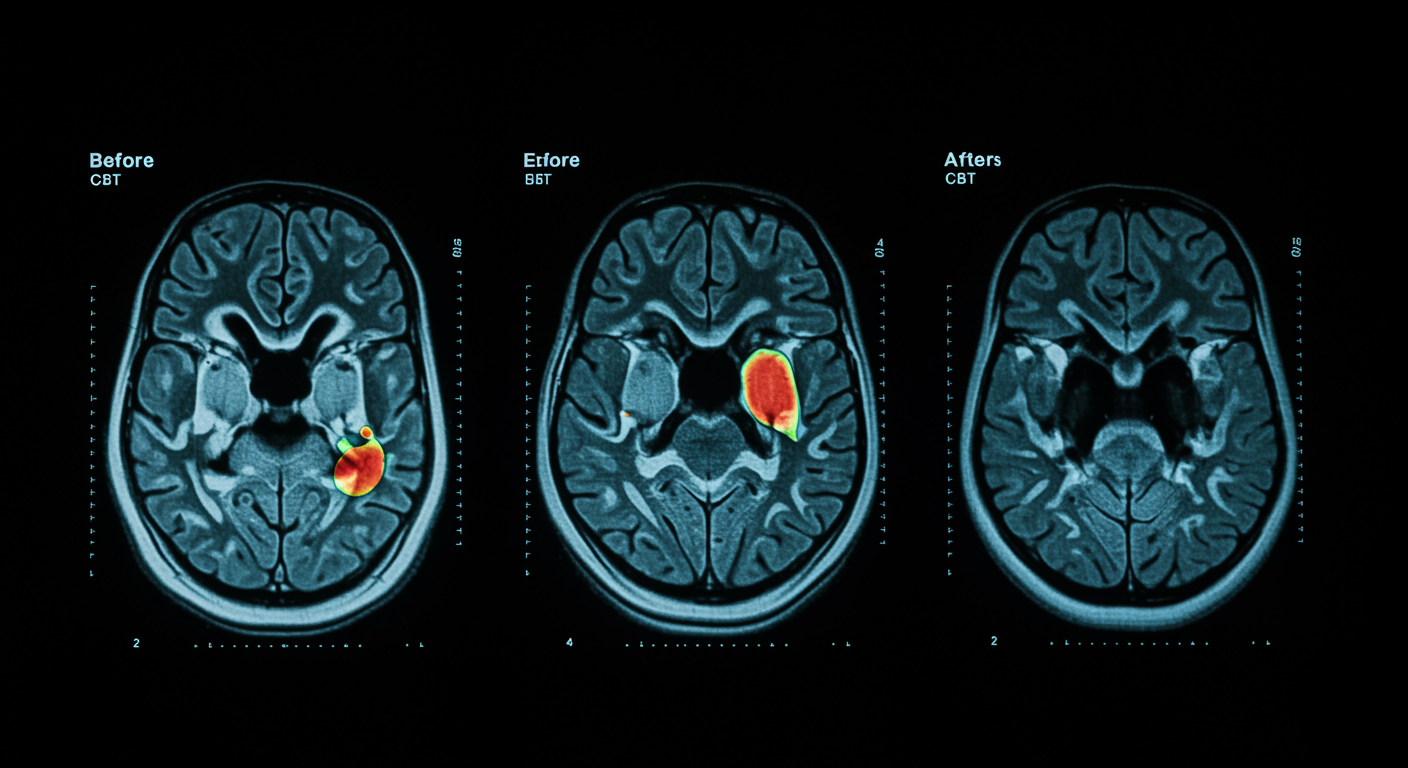
How CBT Changes the Depressed Brain: fMRI Study Reveals Neural Mechanisms
How does CBT change the depressed brain?
Yes. Cognitive behavioral therapy measurably changes brain activity in limbic, striatal, cingulate, and frontal areas, partially normalizing neural patterns associated with depression and reducing negative cognitive biases. A systematic review of 14 task-based fMRI studies published in the Journal of Affective Disorders shows that CBT produces objective, measurable neurobiological changes that correlate with symptom improvement.
What the data show:
- Limbic system changes: Six out of seven studies found significant alterations in amygdala and hippocampus activity, primarily showing reduced reactivity after CBT
- Striatal activity: Four out of five studies reported increased activity in reward processing and decreased activity during affective processing and future thinking
- Cingulate cortex: Six out of nine studies demonstrated altered activity in anterior and posterior cingulate regions, with subgenual anterior cingulate cortex changes most consistently linked to symptom improvement
- Prefrontal cortex: Seven out of eight studies found significant activity changes in frontal areas involved in emotion regulation and cognitive control
- Symptom correlation: Brain activity changes in the subgenual anterior cingulate cortex and prefrontal areas show associations with clinical symptom improvement
- Normalization pattern: CBT appears to reduce limbic hyperactivity while modulating striatal, cingulate, and prefrontal activity to restore more balanced neural processing
- Mechanism: CBT works by reducing bottom-up limbic hyperactivity (particularly in amygdala and hippocampus), increasing top-down cognitive control from prefrontal regions, enhancing striatal reward responsiveness, and normalizing cingulate activity involved in emotion regulation - these changes collectively reduce negative cognitive biases and restore more adaptive neural processing patterns that support recovery from depression
Dr. Kumar’s Take
This systematic review provides the neurobiological proof that CBT isn’t just “talk therapy” - it’s literally rewiring the brain. The fact that we can see measurable changes in limbic, striatal, cingulate, and frontal areas on fMRI scans is remarkable. These are exactly the brain regions we know are dysfunctional in depression. The limbic system processes emotions, the striatum is involved in motivation and reward, the cingulate cortex handles attention and emotion regulation, and the frontal areas manage executive function and decision-making. CBT is essentially teaching the brain new ways to process information and emotions, and we can now see this happening in real-time through brain imaging.