
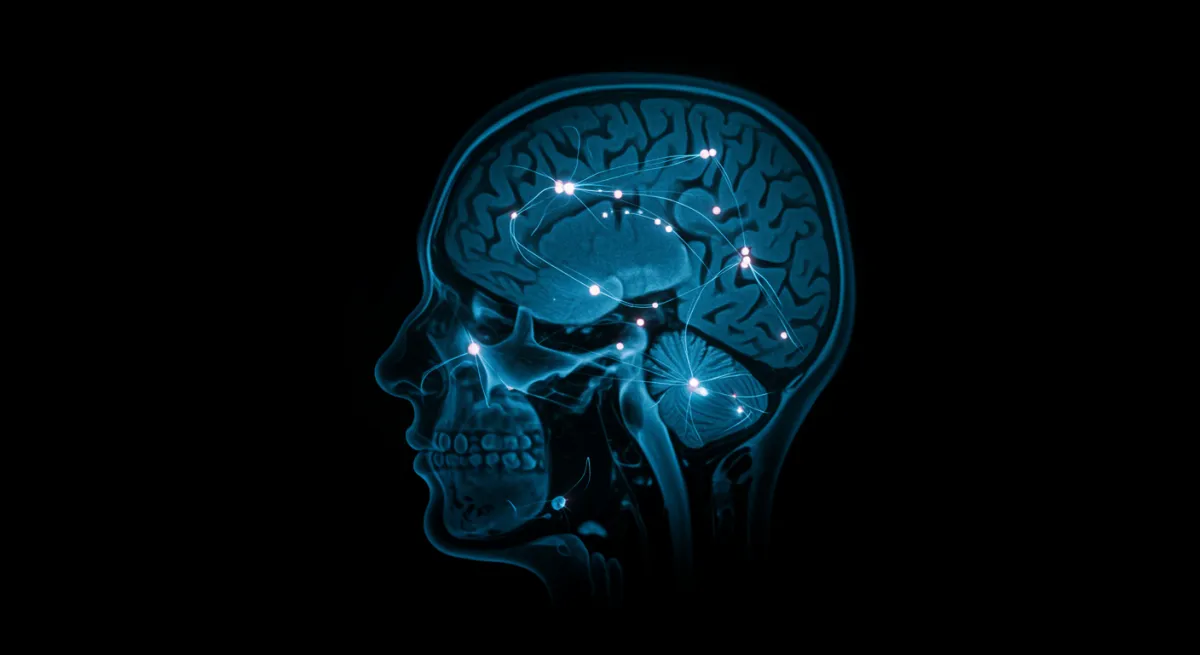
How does depression affect teenage brain networks?
Adolescent depression weakens communication between brain networks responsible for attention and self-reflection, making it harder to switch between internal thoughts and external focus. A neuroimaging study of 30 adolescents with depression and 32 healthy controls found that key brain regions showed reduced ability to regulate each other’s activity.
Depression disrupts communication between the salience network (which filters important information) and the default mode network (active during self-reflection), explaining why depressed teenagers struggle with attention and get trapped in negative thought patterns.
What the data show:
- Network disruption: Brain regions that normally regulate each other show weaker inhibitory connections in depressed adolescents
- Predictive accuracy: Brain connectivity patterns could correctly identify depression status with 76% accuracy in this study
- SSRI effects: Patients taking antidepressants showed different connectivity patterns compared to those not on medication
- Study scope: 30 adolescents with depression and 32 healthy controls examined using advanced brain imaging techniques
A neuroimaging study published in Frontiers in Psychiatry demonstrates that adolescent depression involves specific weakening of connectivity between major brain networks, particularly affecting the communication between salience and default mode networks during rest.
Dr. Kumar’s Take
This research highlights a critical developmental vulnerability - the adolescent brain’s network connectivity is still maturing, making it particularly susceptible to depression-related disruptions. Understanding these specific network changes in teenagers helps explain why adolescent depression often presents differently than adult depression and why targeted interventions during this developmental window are so important.
What the Research Shows
Advanced neuroimaging studies reveal that adolescent depression involves specific disruptions in how major brain networks communicate during resting states. The weakened connectivity between the salience network (which filters important information) and the default mode network (active during internal focus) creates a fundamental communication breakdown that affects cognitive and emotional processing.
Study Snapshot
This neuroimaging study examined resting-state brain connectivity in adolescents with depression compared to healthy controls. Researchers used functional magnetic resonance imaging (fMRI) to measure effective connectivity patterns between major brain networks, focusing specifically on the communication pathways between salience and default mode networks.
Results in Real Numbers
This study examined 30 adolescents with major depressive disorder and 32 healthy controls matched for age, IQ, sex, and handedness. Using advanced brain imaging techniques during a 6-minute resting state scan, researchers analyzed how different brain networks communicate with each other.
The analysis revealed that depressed adolescents showed weaker inhibitory connections between the amygdala (part of the salience network) and key regions of the default mode network, including the medial prefrontal cortex and posterior cingulate cortex. This means the brain regions that normally help regulate each other’s activity were less effective at doing so in depressed teens. Additionally, the medial prefrontal cortex and anterior cingulate cortex showed reduced self-inhibition, making these regions more sensitive to external influences and less able to maintain stable activity patterns.
When researchers tested whether these connectivity patterns could predict which participants had depression, the brain connectivity model achieved 76% accuracy in correctly identifying diagnostic status - significantly better than chance. The anterior cingulate cortex’s self-connection was particularly important for this prediction, achieving 73% accuracy on its own. For the 18 patients taking SSRI antidepressants, the analysis showed that medication was associated with increased self-inhibition in default mode network regions and decreased self-inhibition in the anterior cingulate cortex, suggesting that antidepressants may help restore more normal network function by modulating how sensitive these brain regions are to incoming signals.
How This Works (Biological Rationale)
The salience network normally acts as a “switch” that helps transition between the default mode network (internal focus, self-referential thinking) and task-positive networks (external focus, goal-directed behavior). In adolescent depression, this switching mechanism becomes impaired. Weakened connectivity means the brain struggles to appropriately shift between internal reflection and external engagement, leading to excessive rumination and difficulty with attention regulation.
Why This Matters for Health and Performance
These connectivity changes help explain core symptoms of adolescent depression:
- Attention problems in school and daily activities result from impaired network switching
- Rumination and negative thinking stem from dysregulated default mode network activity
- Social withdrawal may reflect difficulty shifting from internal to external focus
- Academic performance decline often follows from these attention and cognitive changes
Practical Takeaways
- Recognize network-based symptoms as neurobiological rather than behavioral choices in depressed adolescents
- Support interventions that strengthen network connectivity, such as mindfulness training and cognitive behavioral therapy
- Consider developmental timing - adolescent brains are more plastic and potentially more responsive to intervention
- Monitor academic and social functioning as indicators of network connectivity health
- Implement early intervention strategies that target network development during this critical period
Related Studies and Research
Episode 31: Depression Explained — The Biology Behind the Darkness
Episode 32: Depression Recovery Roadmap: A Step-by-Step, Evidence-Based Plan
FAQs
Is weakened brain connectivity in adolescent depression permanent?
No, adolescent brains show high plasticity, and effective treatments can help restore healthy connectivity patterns. Early intervention during this developmental period may be particularly beneficial.
How does adolescent depression differ from adult depression in the brain?
Adolescent depression shows distinct network connectivity patterns, often involving developmental brain regions that are still maturing. These differences may explain why treatment approaches sometimes need to be tailored for younger patients.
Can these brain changes be detected before depression symptoms appear?
Research is exploring whether connectivity changes might serve as early biomarkers, but currently these patterns are identified after depression symptoms are already present.
Bottom Line
Adolescent depression involves specific weakening of connectivity between major brain networks, particularly affecting the communication between salience and default mode networks. Understanding these developmental network changes supports targeted interventions during this critical period of brain maturation.