
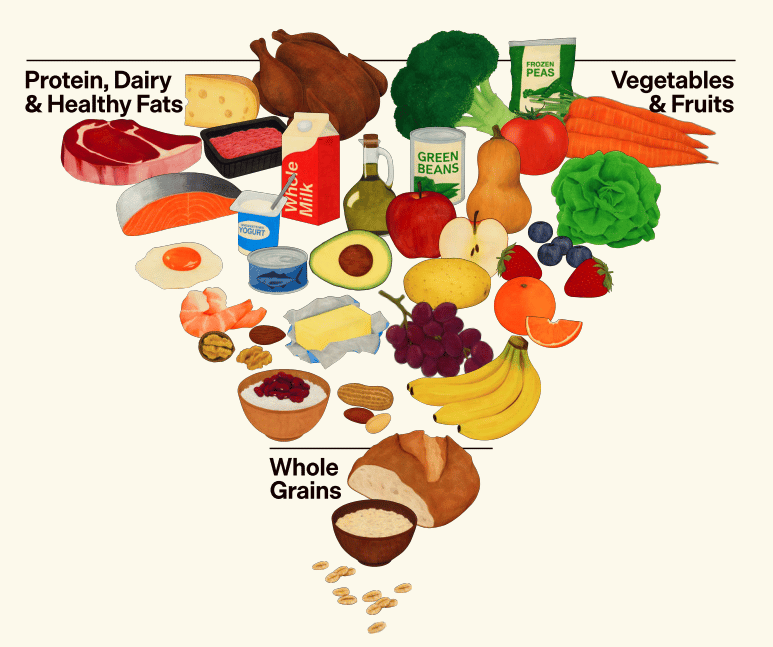
Source: realfood.gov
For decades, America’s official nutrition advice has been shaped by biased data that goes all the way back to the 1960s. The belief that red meat and saturated fat were labeled as villains, while refined carbohydrates and processed food skated by, even sometimes labeled as health foods, has been extremely frustrating. This type of entrenched dogma is very hard to change, as scientists and medical professionals rarely dare to swim against the currents of consensus. (The story about how this came to be is quite fascinating, and I lay it all out in this podcast episode.)
So it’s not surprising to me at all, that it took someone completely outside the medical establishment, RFK Jr., to ignore that old script and force a change.
To be clear, I am not a fan of RFK Jr. There are plenty of things I disagree with him on. But on this one, I think the recommendations are a meaningful improvement in the guidance being given to the American public. The message can be distilled down to this: ‘Eat real food’.
But let’s do a quick run through of the new recommendations.
What actually changed
The new “food pyramid” style graphic puts protein, dairy, and healthy fats at the foundation, then vegetables and fruits , then whole grains.
And the text makes the theme explicit: prioritize whole, nutrient-dense foods and dramatically reduce highly processed foods.
The parts I genuinely like
Here are the highlights, in plain English:
1) Protein is back in the driver’s seat.
They explicitly recommend prioritizing protein at every meal, with a target of 1.2–1.6 g/kg/day.
2) Full-fat dairy is no longer treated like a villain.
They recommend full-fat dairy (with no added sugar) and give a benchmark of 3 servings/day in a 2,000-calorie pattern.
3) They finally say to reduce ultra-processed foods!
They directly tell people to avoid highly processed packaged foods that are salty or sweet, avoid sugar-sweetened beverages, and limit “chemical additives” like artificial flavors, petroleum-based dyes, and certain sweeteners.
That is a huge shift and a great improvement!
Where I disagree (and one factual issue)
There’s a section on fats that I think gets halfway there, then trips over its own feet.
They say: when cooking, “prioritize oils with essential fatty acids, such as olive oil”.
Here’s the problem: olive oil is mostly monounsaturated oleic acid, which is not an essential fatty acid. So that phrasing is just not accurate.
Now, do I think olive oil is healthy? Yes! And I love it. In fact, I drench my food in it. It’s generally more resistant to oxidation than many highly polyunsaturated oils, and it contains loads of polyphenols. A big part of why the Mediterranean diet performs well is that it includes plenty of olive oil as part of a whole-food diet. A great clinical trial call the**** PREDIMED study was done on Mediterranean diet showing it to be remarkably effective for preventing heart disease. I review that study here.
Another place they miss the mark is when they said, “in general, saturated fat consumption should not exceed 10% of total daily calories.”
In my view, putting hard limits on saturated fat has been one of the major drivers of confusion in American nutrition for decades. I talk about how saturated fat got scapegoated 50 years ago and how butter was replaced with ‘I can’t believe it’s not butter’ on all our kitchen tables in this episode of The Dr Kumar Discovery podcast. Saturated fat is resistant to oxidation, and traditional societies have relied on saturated fats for millennia without suffering from the typed of degenerative diseases that plague modern society. This guide should have said, don’t be afraid of butter! But instead it fell short and towed the dogmatic line.
They also still failed to clearly call out: highly polyunsaturated, easily oxidized industrial oils (what most people call “seed oils”). Based on ample scientific data and common sense, seed oils have been an artificial introduction to the human diet that never existed throughout all of human evolution. If you want to learn more about seed oils and how they wreak oxidative havoc on your body, check out this episode of my podcast.
The simplest way to apply this without overthinking it
If you do nothing else, do this:
Build meals around protein + whole foods.
Make ultra-processed snacks and sugary drinks rare.
That’s it. That single shift tends to drag a lot of other good choices behind it.
One final note
These are population-level guidelines. Your health situation matters. If you have diabetes, cardiovascular disease, kidney disease, or you’re on specific meds, you should personalize this with your clinician.
As always, knowledge is power. The more you know, the more capable you are to make good decisions about your health. Your goal in life is to eat and live in a way that actually makes your life, energy, and long-term health better. While I would never tell you to trust the government to tell you how to eat and live, I think these guidelines are finally inching in the right direction!